
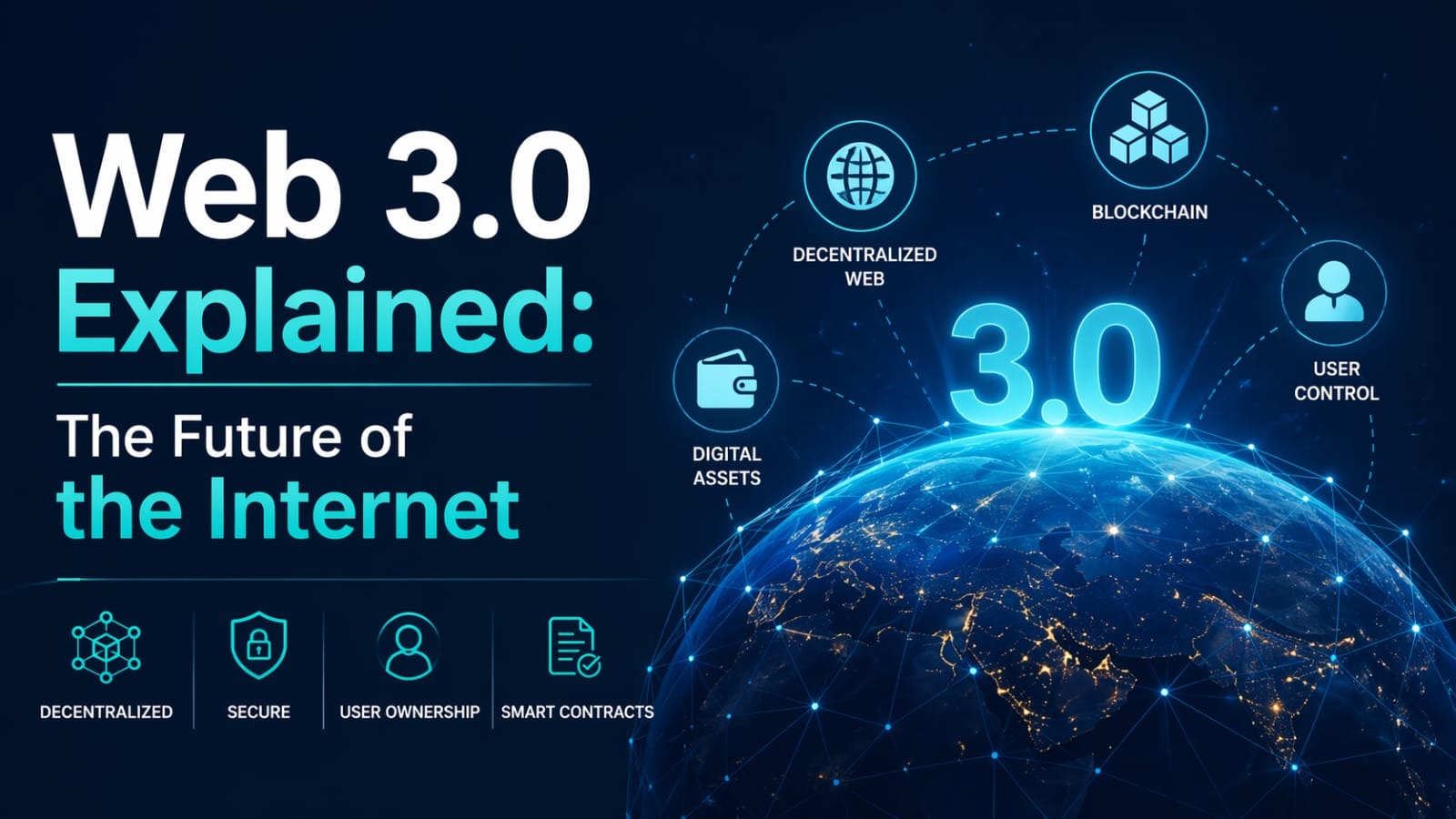
Web 3.0 Explained
The Future of the Internet
• April 2026 • 5 min read
The internet you use every day is not the internet it was — and it is not the internet it is becoming.
For most of its existence, the web has been controlled by a handful of technology giants. Your data, your identity, your digital interactions — all of it passes through centralised servers owned by Google, Meta, Amazon, or Apple. Web 3.0 represents a fundamental rethinking of this model: an internet that is decentralised, owned by its users, and built on open protocols rather than corporate infrastructure.
This blog explains what Web 3.0 actually is, how it differs from what came before, what technologies power it, and what it means for developers, businesses, and everyday users.
🌐 What is Web 3.0? Web 3.0 (also written Web3) is the next generation of the internet, built on blockchain technology, decentralised protocols, and token-based economics. Its defining principle is that users — not corporations — own and control their data, identity, and digital assets. It replaces the trust-in-corporations model of Web 2.0 with trust-in-code through verifiable, open-source smart contracts. |
The Evolution of the Web
To understand Web 3.0, you first need to see what it is evolving from.
Era | Period | Key Traits | Examples |
|---|---|---|---|
Web 1.0 | 1991 – 2004 | Static pages, read-only, no user accounts | Early websites, HTML pages, GeoCities |
Web 2.0 | 2004 – present | Dynamic, interactive, user-generated content, centralised platforms | Facebook, YouTube, Twitter, Google, Airbnb |
Web 3.0 | 2020s onward | Decentralised, user-owned, permissionless, trustless, token-based | Ethereum, Solana, IPFS, ENS, DeFi, NFTs |
The 3 Core Pillars of Web 3.0
⛓ Decentralisation No single entity controls the network. Data lives across thousands of nodes rather than one company's servers. | 🔐 Trustlessness Interactions are governed by smart contracts — open code on a public blockchain — not by corporate terms of service. | 🪙 Token Economics Native tokens incentivise participants to contribute resources and governance, aligning user interest with network health. |
Key Technologies Powering Web 3.0
Blockchain
A blockchain is a distributed ledger: a chain of records (blocks) that is replicated across thousands of nodes and can only be updated by consensus. Because no single party controls it, records are tamper-proof and publicly verifiable. Ethereum is the dominant smart-contract blockchain; alternatives like Solana, Avalanche, and Polkadot offer different speed and cost trade-offs.
Smart Contracts
Smart contracts are self-executing programs stored on a blockchain. They run automatically when predefined conditions are met — no lawyers, no banks, no intermediaries required. A smart contract can hold funds in escrow, issue tokens when a purchase is made, or distribute revenue to creators — all without human intervention.
💡 Analogy Think of a smart contract like a vending machine: put in the right input (money + selection), and it automatically delivers the right output (your snack). No cashier, no trust required. The machine's rules are fixed and visible to everyone. |
Decentralised Storage — IPFS & Filecoin
Today, your files stored in a Google Drive or Dropbox live on servers Google or Microsoft own. If they shut down or restrict access, your data is gone. IPFS (InterPlanetary File System) stores files across a distributed network of nodes, addressed by content hash rather than server location. Filecoin adds economic incentives for nodes to store data reliably.
Decentralised Identity — ENS & DIDs
In Web 2.0, your identity is a username and password managed by a platform. In Web 3.0, your identity is a cryptographic key pair you own — a wallet address like 0x4F3a... or a human-readable name like aiman.eth (via Ethereum Name Service). Decentralised Identifiers (DIDs) extend this concept to verifiable credentials that no single authority can revoke.
Decentralised Finance (DeFi)
DeFi is Web 3.0 applied to financial services. Lending, borrowing, trading, earning interest — all done through smart contracts on public blockchains, without banks. By mid-2024, over $100 billion in assets were locked in DeFi protocols. The trade-off: no customer support, no reversals, and smart contract bugs can be costly.
Web 2.0 vs Web 3.0 — A Direct Comparison
Dimension | Web 2.0 | Web 3.0 |
|---|---|---|
Data Ownership | Platform owns your data | You own your data via cryptographic keys |
Identity | Username/password per platform | One wallet address, portable everywhere |
Payments | Visa/Mastercard, bank accounts | Native crypto, permissionless & borderless |
Trust Model | Trust the company | Trust the code (open-source smart contracts) |
Censorship | Platform can ban/deplatform you | Censorship-resistant by design |
Monetisation | Platform takes the cut | Creator earns directly via tokens/NFTs |
Real-World Applications
🎨 NFTs & Creator Economy Non-fungible tokens let artists sell digital work directly to buyers, with royalties automatically distributed on every resale via smart contract — eliminating gallery commissions and platform fees. | 🏛 DAOs — Decentralised Orgs Decentralised Autonomous Organisations are companies governed by token holders via on-chain voting. No CEO, no HQ — just code, community, and a shared treasury. |
🎮 Web3 Gaming In Web3 games like Axie Infinity, players truly own their in-game assets as NFTs. Items can be sold on open markets, and players can earn tokens with real economic value. | 🌍 Cross-Border Payments Stablecoins like USDC allow instant, near-zero-cost international transfers without banks or FX fees — critical for remittances in developing economies like India and Nigeria. |
Challenges & Criticisms
Web 3.0 is still maturing, and its critics raise legitimate concerns:
- Scalability — most blockchains still process far fewer transactions per second than centralised systems (Visa handles ~24,000 TPS; Ethereum handles ~15 without Layer 2 solutions)
- User experience — seed phrases, gas fees, and wallet management are still too complex for mainstream adoption
- Environmental impact — Proof-of-Work blockchains (like early Ethereum) consumed enormous energy; Proof-of-Stake is a significant improvement
- Speculation and fraud — the crypto space has been rife with scams, rug pulls, and extreme price volatility that undermine trust
- Regulatory uncertainty — governments are still developing frameworks for crypto assets, DeFi, and digital identity
⚖️ Balanced View Web 3.0 is not a silver bullet. Decentralisation introduces genuine trade-offs — slower transactions, harder error recovery, and steeper learning curves. The question is not whether Web 3.0 will replace Web 2.0 entirely, but which use cases genuinely benefit from decentralisation and where centralised services remain the better practical choice. |
Key Takeaways
✅ Summary
|