
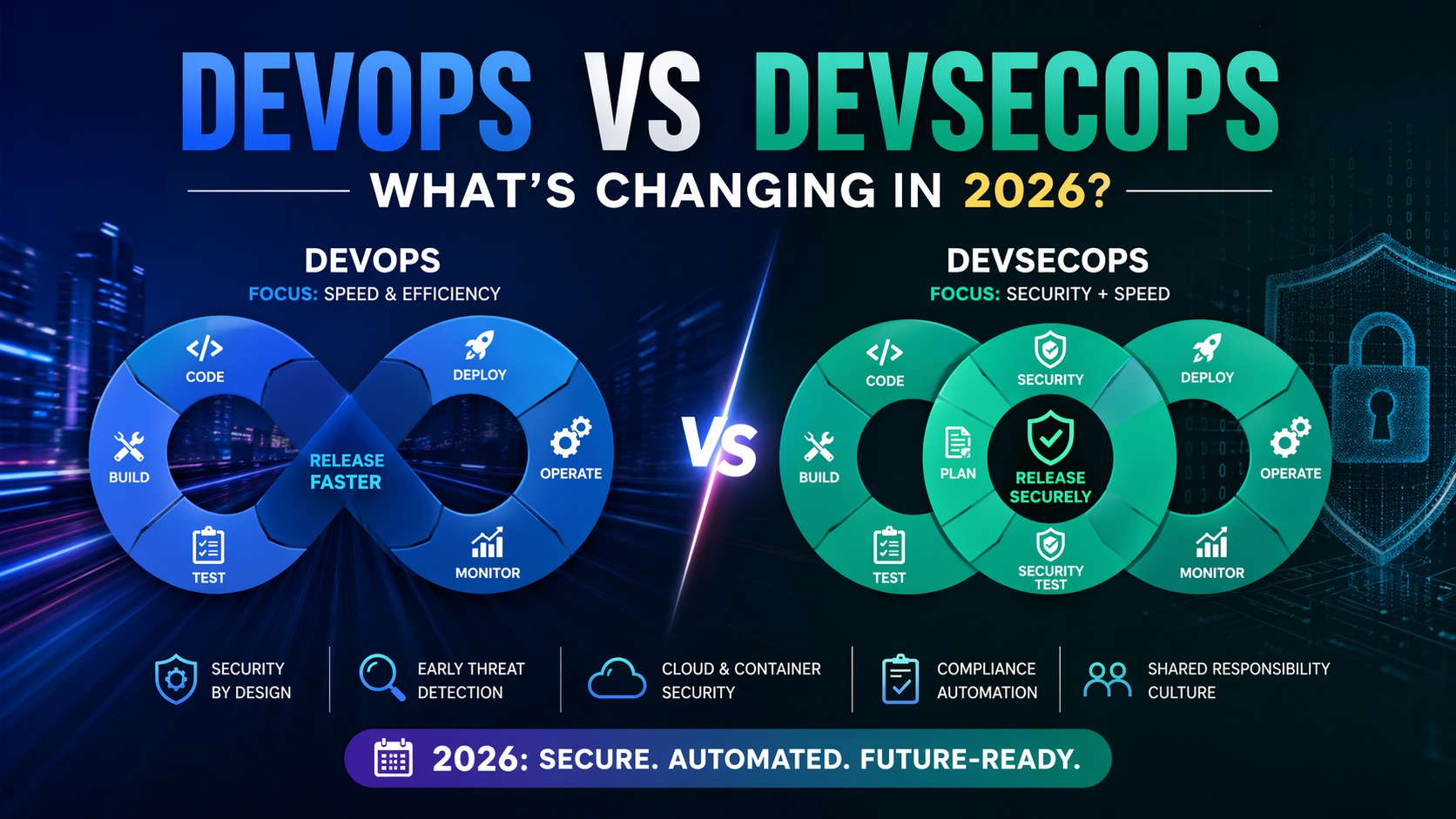
🚀 DevOps vs DevSecOps: What’s Changing in 2026?
📌 Introduction
In today’s fast-paced digital world, organizations are under constant pressure to deliver software faster, safer, and more efficiently. This is where DevOps and DevSecOps come into play.
While DevOps revolutionized software delivery by improving speed and collaboration, DevSecOps is now redefining the game by embedding security directly into the development lifecycle.
As we step into 2026, the shift from DevOps to DevSecOps is no longer optional—it’s becoming the industry standard.
🔧 What is DevOps?
DevOps is a combination of Development (Dev) and Operations (Ops) aimed at improving collaboration, automation, and continuous delivery.
👉 Key goal: Deliver software faster and more reliably
🔑 Core Features:
- Continuous Integration & Continuous Deployment (CI/CD)
- Automation of workflows
- Faster release cycles
- Collaboration between teams
DevOps focuses on speed, efficiency, and rapid delivery.
🔐 What is DevSecOps?
DevSecOps stands for Development + Security + Operations.
It extends DevOps by integrating security at every stage of the software lifecycle instead of adding it at the end.
👉 Key goal: Build secure software from day one
🔑 Core Features:
- Security integrated into CI/CD pipelines
- Automated vulnerability scanning
- Compliance checks
- Shared responsibility for security
DevSecOps ensures security is “shifted left”—meaning it starts early in development.
⚔️ DevOps vs DevSecOps: Key Differences
Feature | DevOps | DevSecOps |
|---|---|---|
Focus | Speed & efficiency | Security + speed |
Security Role | Added later | Built-in from start |
Teams | Dev + Ops | Dev + Ops + Security |
Risk Handling | Reactive | Proactive |
Automation | Deployment-focused | Deployment + security automation |
👉 In simple terms:
- DevOps = Build fast
- DevSecOps = Build fast AND secure
🔄 What’s Changing in 2026?
1. 🔥 DevSecOps is Becoming Mandatory
In 2026, security is no longer optional. Organizations must integrate it from the beginning due to increasing cyber threats and compliance requirements.
2. 🤖 Rise of AI-Generated Code
AI tools are now generating a large portion of code.
- Around 42% of enterprise code is AI-generated
- This increases productivity
- But also introduces new security risks
👉 Result: DevSecOps is essential to secure AI-generated code.
3. 🔐 Shift-Left + Shift-Right Security
Security is now applied:
- Shift Left → During coding
- Shift Right → During runtime monitoring
This ensures continuous security across the lifecycle.
4. ☁️ Cloud & Container Security Boom
With cloud-native apps (Docker, Kubernetes), security challenges have increased.
DevSecOps now includes:
- Container security
- API security
- Infrastructure as Code (IaC) scanning
5. 📊 Compliance Automation
Regulations like GDPR, HIPAA, and SOC2 require strict compliance.
👉 DevSecOps automates:
- Compliance checks
- Audit trails
- Security reporting
6. 🔁 Continuous Security Monitoring
Instead of periodic testing, companies now use:
- Real-time threat detection
- Continuous vulnerability scanning
7. 🧠 Cultural Shift: Security is Everyone’s Job
Earlier:
- Security team worked separately
Now:
- Developers, testers, and ops teams share responsibility
👉 This is the biggest mindset change in 2026.
📈 Why DevSecOps is Replacing DevOps
🚨 Reason 1: Cost of Security Failures
Fixing issues later is extremely expensive
- ~$80 during development
- ~$7600 in production
⚡ Reason 2: Faster & Safer Releases
DevSecOps ensures:
- Fewer bugs
- Secure deployments
- Better user trust
🔍 Reason 3: Increasing Cyber Threats
Modern apps face:
- Data breaches
- API attacks
- Cloud vulnerabilities
👉 DevSecOps helps prevent these risks early.
🧩 Real-World Example
DevOps Approach:
- Develop code
- Test
- Deploy
- Check security later ❌
DevSecOps Approach:
- Develop code
- Scan for vulnerabilities
- Test securely
- Deploy safely ✔️
🛠️ Popular Tools in 2026
DevOps Tools:
- GitHub / GitLab
- Jenkins
- Docker
- Kubernetes
DevSecOps Tools:
- Snyk
- Aqua Security
- OWASP ZAP
- HashiCorp Vault
🚀 Future Trends Beyond 2026
- AI-powered security automation
- Zero Trust Architecture
- DevSecOps + MLOps integration
- Software supply chain security
👉 DevOps will continue evolving, but DevSecOps will dominate.
📝 Conclusion
In 2026, the difference between DevOps and DevSecOps is clear:
- DevOps focuses on speed and delivery
- DevSecOps focuses on secure, reliable delivery
👉 The biggest change?
Security is no longer a separate step—it’s a core part of development.
💡 Final Thought:
“You can’t build fast if you’re constantly fixing security issues.”