
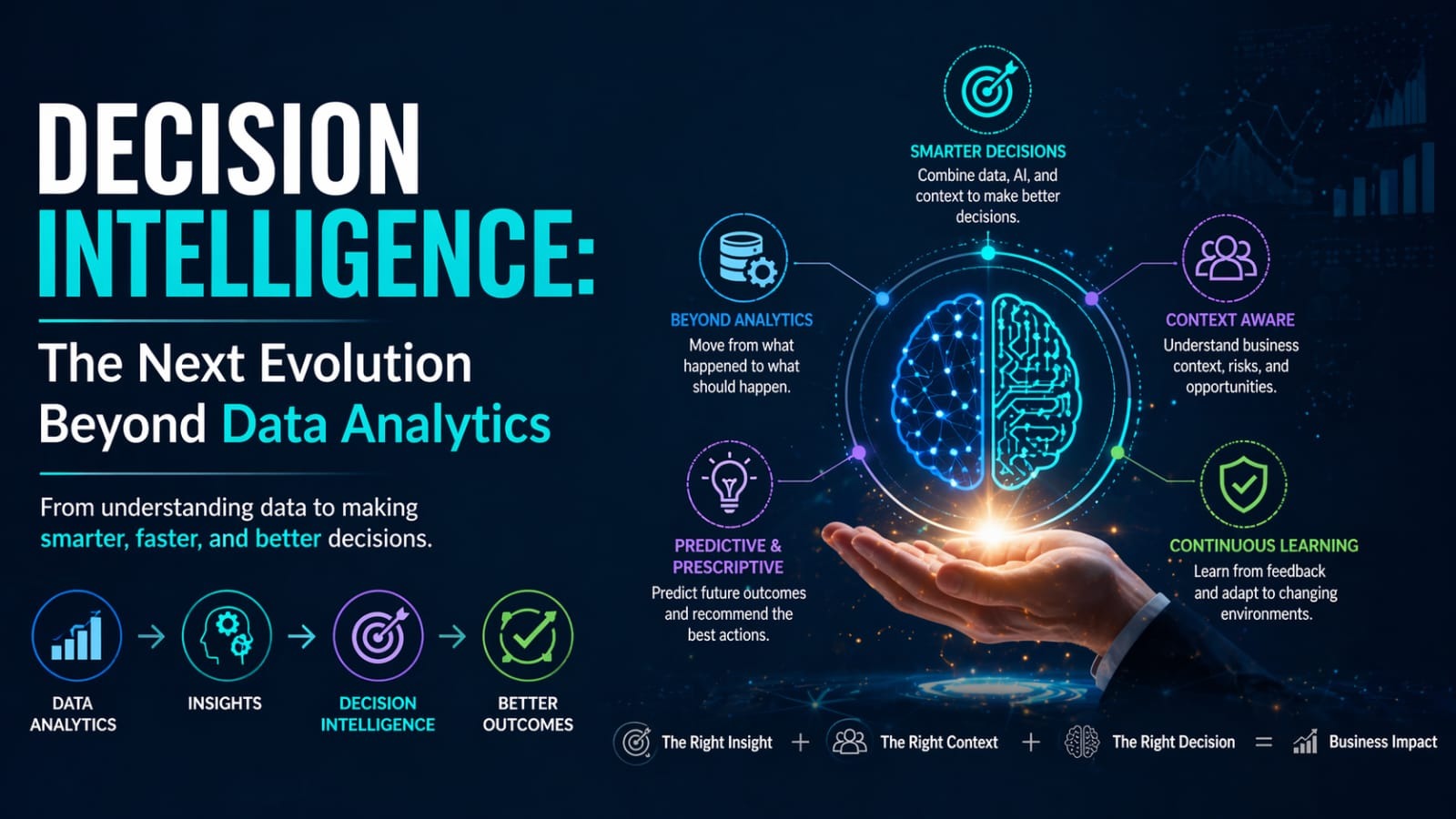
Decision Intelligence
The Next Evolution Beyond Data Analytics
• April 2026 • 5 min read
Data analytics tells you what happened. Decision Intelligence tells you what to do about it.
For decades, organisations have invested heavily in dashboards, reports, and data warehouses — all designed to surface insights. Yet, the gap between insight and action has remained frustratingly wide. Decision Intelligence (DI) is the emerging discipline that bridges this gap, combining data science, behavioural science, and AI to systematically improve how decisions are made at every level of an organisation.
What is Decision Intelligence? Decision Intelligence is the application of social science, data science, and managerial science to the full decision-making process — from framing the problem correctly, to choosing actions, to learning from outcomes. It was formally defined by Google Cloud's Chief Decision Scientist, Cassie Kozyrkov, as a practical discipline that treats decisions as engineering problems. |
Data Analytics vs Decision Intelligence
The distinction isn't about replacing analytics — it's about completing the loop that analytics leaves open.
Dimension | Data Analytics | Decision Intelligence |
|---|---|---|
Focus | Understanding the past | Driving future actions |
Output | Dashboards, reports, insights | Recommended decisions, automated actions |
Question | What happened? Why did it happen? | What should we do? What will happen if we do X? |
Discipline | Statistics, SQL, BI tools | AI, behavioural science, systems thinking |
Loop | Open-ended — insight stops here | Closed — feedback from outcomes informs next decision |
The 4 Pillars of Decision Intelligence
Decision Framing Defining the right question before reaching for data | Data & Models Using analytics and ML to quantify options and risks | Behavioural Science Accounting for human bias and cognitive limits | Feedback Loops Learning from outcomes to sharpen future decisions |
Real-World Applications
1. Retail — Dynamic Pricing at Amazon
Amazon does not simply analyse historical sales data. Its Decision Intelligence engine continuously evaluates competitor prices, demand signals, inventory levels, and user behaviour to make millions of automated pricing decisions per day. The system doesn't just report "competitor X dropped price by 5%" — it decides whether to match, undercut, or hold, and then learns from the sales outcome.
2. Healthcare — Clinical Decision Support
Hospitals like Mayo Clinic use DI systems to assist doctors with treatment decisions. Rather than showing a physician a patient's historical chart, the system frames the decision ("should this patient receive drug A or B?"), surfaces relevant evidence, flags cognitive biases (e.g., recency bias), and tracks outcome data to improve future recommendations.
3. Finance — Loan Approval Automation
Traditional credit scoring tells a bank how risky a borrower appears. A Decision Intelligence system goes further: it frames the decision in context (purpose of loan, macroeconomic conditions), models multiple outcomes (default probability, customer lifetime value), and recommends an approval threshold — while ensuring fairness constraints are met and regulators can audit the logic.
Key Insight In each example, the shift from analytics to DI is the same: the system doesn't stop at insight — it owns the decision loop. Data flows in, a recommendation (or automated action) flows out, and the outcome feeds back to improve the next cycle. |
Why is Decision Intelligence Emerging Now?
Three forces are converging to make DI viable at scale:
- Mature AI/ML infrastructure — pre-trained models, MLOps platforms, and AutoML reduce the cost of building decision models.
- Behavioural economics going mainstream — organisations now recognise that human decision-making is systematically biased and needs engineering around it.
- Data maturity — companies that have spent years building data warehouses now have the raw material to feed closed-loop systems.
Gartner identified Decision Intelligence as a Top 10 Strategic Technology Trend, noting that by 2023 more than a third of large organisations would have analysts practicing DI.
How to Start Applying Decision Intelligence
You don't need to overhaul your entire data stack. Start small:
- Pick one high-stakes, repeating decision in your organisation (e.g., which leads to prioritise, which SKUs to restock).
- Map the decision: what information is needed, who decides, what actions are possible, how is success measured?
- Build a simple model that recommends an action — even a rule-based one to start.
- Create a feedback loop: track what happens after each decision and use it to retrain or refine the model.
✅ Key Takeaways
|