
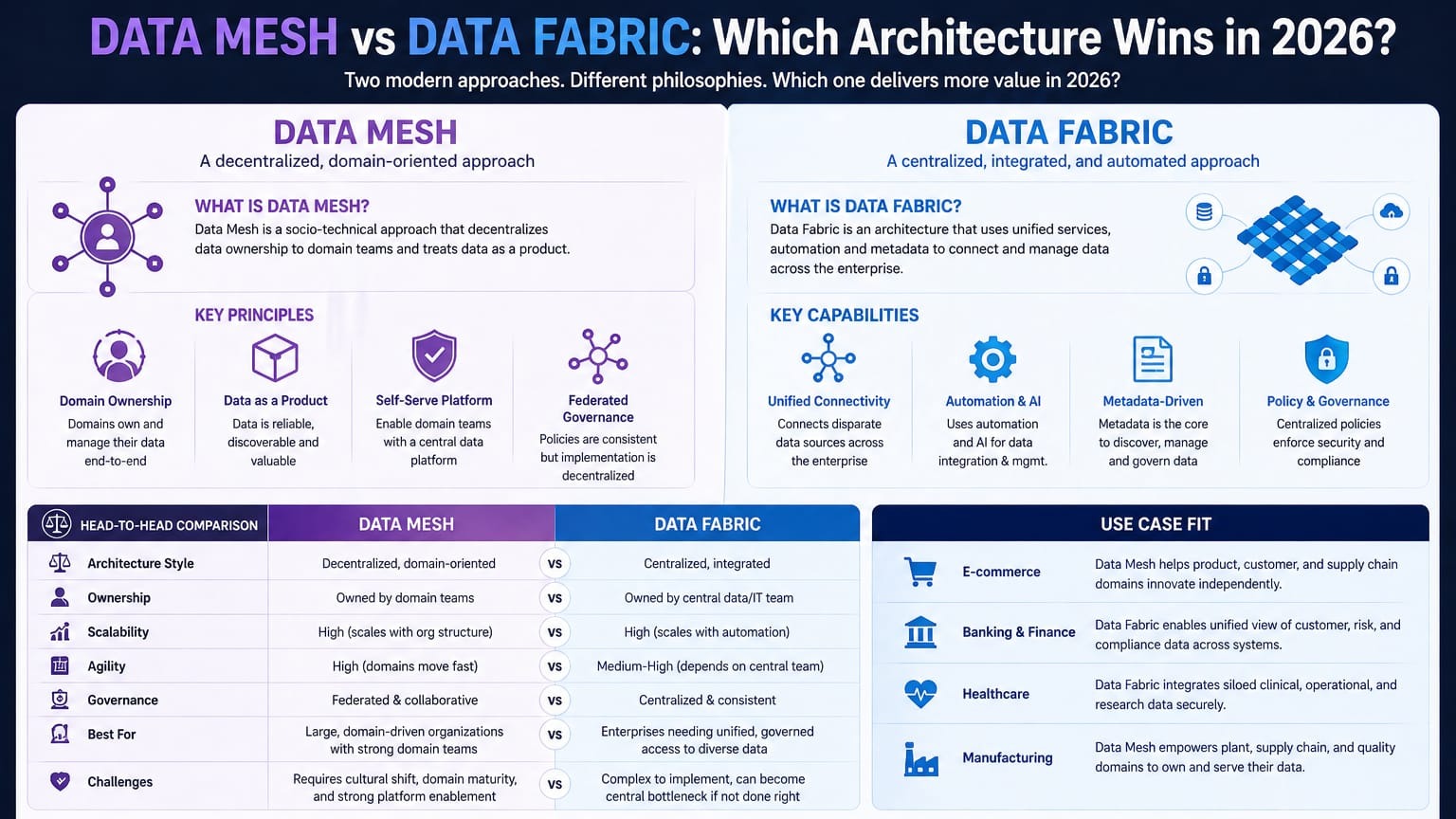
Data Mesh vs Data Fabric (2026): Which Architecture Wins?
In the modern data era—driven by AI, real-time analytics, and multi-cloud systems—organizations face a critical decision:
Should they adopt Data Mesh or Data Fabric?
For years, this debate sounded like a competition. But in 2026, the reality is different.
What is Data Fabric?
Data Fabric is a technology-driven architecture that connects and manages data across systems using:
Metadata
AI Automation
Unified Governance
It creates a single intelligent layer over distributed data systems.
Key idea:
Centralized intelligence + automated integration
✔ Best for:
Multi-cloud environments
AI/ML-ready data platforms
Strong governance & compliance
In simple terms:
Data Fabric = “Smart centralized data brain”
What is Data Mesh?
Data Mesh is a people + process-driven architecture where:
Data ownership is decentralized.
Teams (domains) manage their own data.
Data is treated as a product.
It shifts responsibility from central IT to business teams.
Key idea:
Decentralized ownership + domain-driven data
✔ Best for:
Large organizations
Complex business domains
Faster decision-making
In simple terms:
Data Mesh = “Distributed ownership of data”
Data Mesh v/s Data Fabric:
Factor
Data Fabric
Data Mesh
Focus
Technology & Automation
Organization & Ownership
Control
Centralized Intelligence
Decentralized Domains
Governance
Automated, Centralized
Federated (shared rules)
Scalability
Technical Scalability
Organizational Scalability
Complexity
Easier to Implement
Hard cultural shift
Core Difference:
Fabric = How data flows
Mesh = Who owns data
Why Companies Use Both:
Modern enterprises are combining both:
Hybrid Approach (Winning Strategy):
Data Fabric handles:
Integration
Metadata
Governance
Automation
Data Mesh handles:
Ownership
Domain expertise
Data quality at source
Result:
Faster insights
Scalable AI system
Better data trust
Industry Trends (2026):
AI systems require clean, unified data 🡪 Fabric shines
Large orgs need domain ownership 🡪 Mesh shines
Hybrid architectures are becoming default
Even in AI driven systems :
Centralized data layers (fabric-like) improve reliability
Fully decentralized mesh alone can be complex to manage
2026 Reality: There Is NO Single Winner:
Here’s the biggest insight:
Data Mesh vs Data Fabric is not a competition anymore.
In 2026, experts agree:
They are complementary, not competing architectures
Real – World Challenges:
Data Mesh Challenges:
Requires cultural shift
Teams must handle data engineering
Hard to implement successfully
Data Fabric Challenges:
Can become overly centralized
Requires strong tooling investment
Which Architecture Wins?
Hybrid wins in 2026
Choose data fabric if:
You want quick implementation
Strong governance & compliance needed
Focus is on AI + Automation
Choose data mesh if:
You have large, complex organization
Need domain ownership
Want to scale data products
Best Choice:
Data Fabric + Data Mesh Together
Conclusion:
In 2026, the real winner is not Data Mesh or Data Fabric individually, but a hybrid architecture that blends the strengths of both—combining decentralized ownership with centralized intelligence to build scalable, AI-ready data ecosystems.