
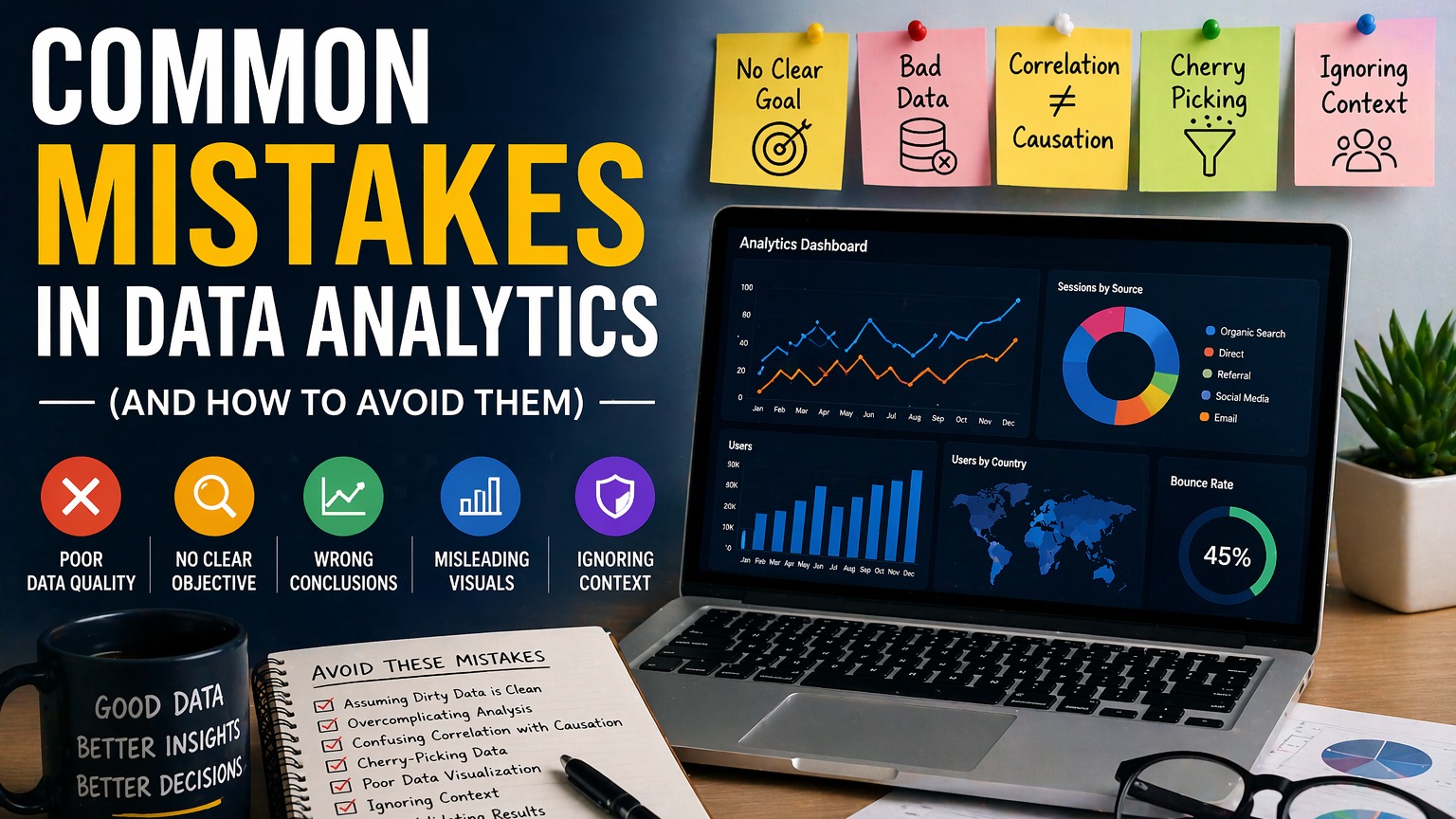
Common Mistakes in Data Analytics (and How to Avoid Them)
Data analytics is powerful—but only when done right. Many beginners (and even experienced professionals) fall into avoidable traps that lead to misleading insights, wasted time, or poor decisions. If you want your analysis to actually drive value, you need to recognize these mistakes early and correct them.
Here are some of the most common pitfalls in data analytics—and how to avoid them.
1. Starting Without a Clear Question
The mistake:
Jumping into data without a defined objective. This leads to random exploration and unfocused results.
Why it’s a problem:
Without a clear question, you can’t measure success. You end up with interesting—but useless—insights.
How to avoid it:
Define your goal before touching the data. Ask:
- What decision am I trying to support?
- What problem am I solving?
A simple, sharp question beats a vague exploration every time.
2. Ignoring Data Quality
The mistake:
Assuming your data is clean, complete, and accurate.
Why it’s a problem:
Bad data leads to bad conclusions—no matter how advanced your analysis is.
How to avoid it:
Always perform data cleaning:
- Handle missing values
- Remove duplicates
- Check for inconsistencies
- Validate sources
Think of it this way: analysis on poor data is just polished nonsense.
3. Overcomplicating the Analysis
The mistake:
Using complex models when simple methods would work just as well.
Why it’s a problem:
Complexity increases the chance of errors and makes results harder to interpret.
How to avoid it:
Start simple:
- Use basic statistics first
- Build complexity only if needed
- Prioritize clarity over sophistication
A simple model you understand is more valuable than a complex one you don’t.
4. Confusing Correlation with Causation
The mistake:
Assuming that because two variables are related, one causes the other.
Why it’s a problem:
This leads to flawed decisions and false narratives.
How to avoid it:
- Look for underlying factors
- Use controlled experiments when possible
- Be cautious with conclusions
Correlation is a clue—not proof.
5. Cherry-Picking Data
The mistake:
Selecting only data that supports your hypothesis.
Why it’s a problem:
This creates biased results and undermines credibility.
How to avoid it:
- Analyze the full dataset
- Report both supporting and contradicting findings
- Stay objective
Good analysts don’t try to “win”—they try to be accurate.
6. Poor Data Visualization
The mistake:
Using confusing charts or misleading visuals.
Why it’s a problem:
Even correct analysis can be misunderstood if presented poorly.
How to avoid it:
- Choose the right chart type
- Avoid clutter
- Label clearly
- Keep it simple
If someone can’t understand your chart in 10 seconds, it needs fixing.
7. Ignoring Context
The mistake:
Analyzing data without understanding the business or real-world context.
Why it’s a problem:
Numbers alone don’t tell the full story.
How to avoid it:
- Learn the domain you’re working in
- Talk to stakeholders
- Connect data to real-world outcomes
Data without context is just noise.
8. Not Validating Results
The mistake:
Trusting results without checking their reliability.
Why it’s a problem:
You might be making decisions based on errors or anomalies.
How to avoid it:
- Cross-check with other methods
- Use test datasets
- Reproduce results
If your analysis can’t be validated, it shouldn’t be trusted.
9. Overlooking Data Privacy and Ethics
The mistake:
Using data without considering privacy or ethical implications.
Why it’s a problem:
This can lead to legal issues and loss of trust.
How to avoid it:
- Follow data protection regulations
- Anonymize sensitive data
- Use data responsibly
Just because you can analyze something doesn’t mean you should.
10. Failing to Communicate Insights Clearly
The mistake:
Presenting raw data instead of actionable insights.
Why it’s a problem:
Stakeholders don’t care about numbers—they care about decisions.
How to avoid it:
- Focus on key takeaways
- Use simple language
- Provide recommendations
Your job isn’t just analysis—it’s communication.
Final Thoughts
Data analytics isn’t just about tools or techniques—it’s about thinking clearly and avoiding common traps. Most mistakes don’t come from lack of skill, but from lack of discipline and structure.
If you focus on:
- Clear goals
- Clean data
- Simple methods
- Honest interpretation
—you’ll already be ahead of most analysts.
And here’s the blunt truth: accuracy matters more than sophistication. Get the basics right, and everything else becomes easier.